Secure checkout: Visa, Mastercard, PayPal, Apple Pay
What this book is for
If the power goes out, or the trucks stop, how many days of food are actually in your house?
Most houses have about three days. The grocery store has about three more. After that you are on what you already have at home — the dry shed, the stove, the jars, the woodpile you stacked when the ground was still soft.
People used to get through a short growing season because they knew how to do the work. How to keep a shed dry. How to run a wood stove. How to grow food in ninety days. How to can it before the frost. The tools were never the missing part. A written how-to was.
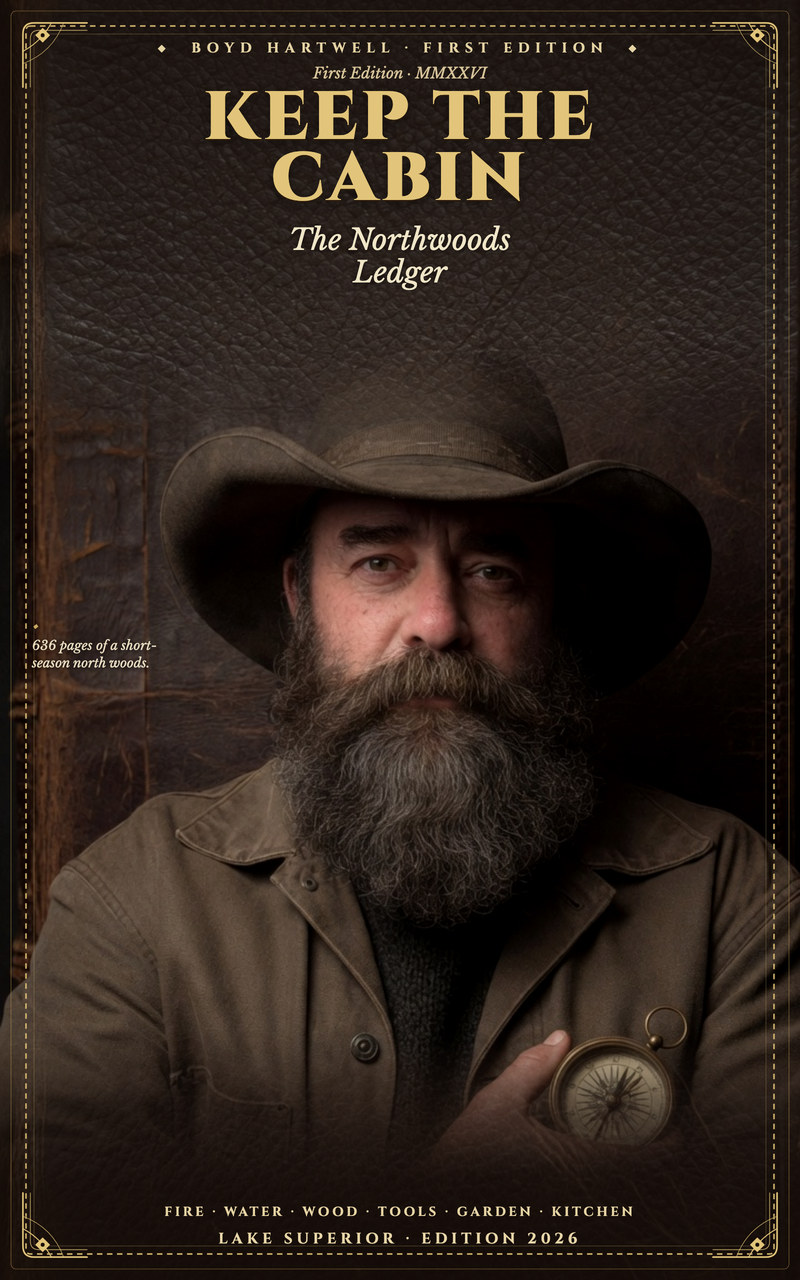
Everything my grandparents knew, written down as a working homestead guide: 129 how-to chapters you can open and actually follow.
Putting food byRoot cellar, sand-store roots, freeze it, sauerkraut by weight, pickles, jam, tomatoes, pressure canner as a machine.
Maple, berries, wild foodTap to syrup. Blueberries as food. An honest list of what this book will not tell you to eat.
Travel, snow, mudPacked trail, snowshoes and a toboggan, April mud, and ice you do not treat as a road.
Clothing and kitWool, oilcloth, mitts you can work in, the small kit that leaves the nail, kerosene and a headlamp.
Small livestockChickens in a cold place, eggs, and what to do when an animal is sick.
Line, cache, storeA cache you can find tired, the store as part of the plan, pelts and meat as grocery.
Weather as a work toolKeep a weather column, work a lake-effect day, wind and the stove.
CloseA week of meals from this book, a year of jobs on one page, and sources.
Read a page before you buy
Here is how the wet-wood fire chapter reads, straight from the book. Every chapter runs the same way: the job, the gear, the steps, and how you know it’s done.
Firep. 71
15. Two-match fire in dripping cedar
Light a fire when the woods are wet.
Get a flame out of woods that have been dripping since Tuesday, with two matches and the dry inside of a round that looks hopeless from the bark. I have watched a man empty a catalog ferro rod onto that bark until the sparks died in the wet. The cedar in the draw will still be dripping. The fire still has to go.
Gear
Lay this out before you strike anything. Count two matches before you strike.
Matches from the lidded tin. A paper box from a wet pocket will fail.
A knife that will shave. A hatchet or the shed axe, for the split.
Water you can pour when you are done. Fill a pail before you strike.
Two-match fireCh. 15
How to light it
…
One match. Strike it in the tin’s lee, or in your cupped hand, and put it to the tinder through the mouth. Keep the flame off the wet bark of the outer sticks. The curls should catch with a small, busy flame you can hold. If the first match dies before the tinder takes, rebuild the pile and use the second match on the new curls.
…
How you know it’s done
After, write it: which tree, whether the heart was dry, how many matches. A fire you cannot start twice will not teach you the next wet Tuesday.
Hen’s margin. Split a down jack pine. Shave the dry heart. Leave air around the tinder. Keep dripping cedar off the first flame.
Excerpt from Chapter 15. Skipped lines are marked “…”.
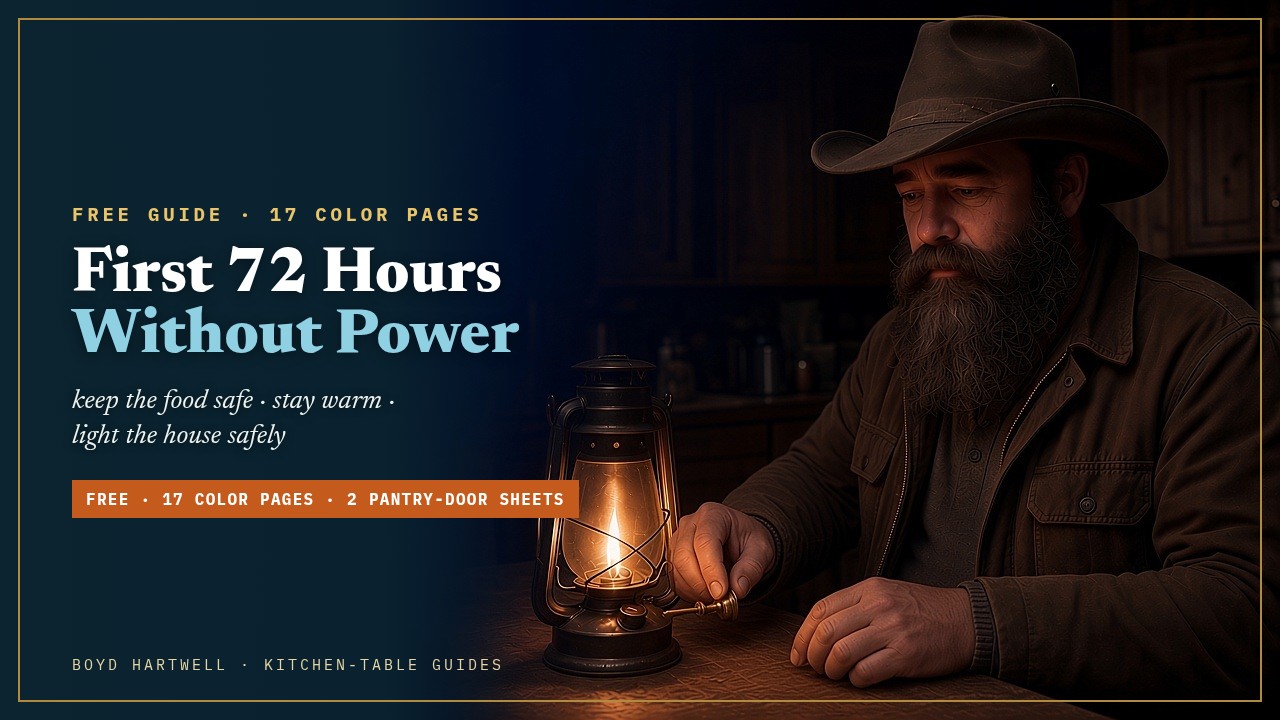
Free · printable · 17 color pages
Free: First 72 Hours Without Power guide
What to do in the first hour, how long the food in your fridge and freezer stays safe, how to stay warm or cool without poisoning the air, and what to do when the power comes back. Read it once, tape the two sheets inside the pantry door, and you'll know what to do the minute the lights go out.
The first hour in six steps, and a 20-point house check
The food clock: fridge, freezer, the 40°F rule, and what to keep or toss
Carbon monoxide and generators, safe heat, safe light, summer heat
Phones, medicine, neighbors, frozen pipes, the sump, and when the power comes back
Two printable sheets, plus six old skills from the Ledger for a dark house
You'll also get word when the next Kitchen-Table Guide is ready. Unsubscribe any time.
A few of the how-tos, with the page numbers
How to start a fire when the wood is wetFatwood, birch bark, kindling that is actually dry, and a stove that draws
p. 71
How to get drinking water in campBoil, filter, or drops. Why melting snow is extra work, not a free well
p. 116
How to keep a cold pantry without a fridgeA north-side corner, shade, and what spoils if you skip the drain
p. 61
How to cut, split, and stack next winter’s woodA cord you can measure, a stack that dries, birch and cedar
p. 186
How to grow and store potatoesThe crop that pays a short season, and the one that rots in the bin
p. 246
How to plant garlic in SeptemberFall planting, not a grocery bag in March
p. 256
How to use a compass when the rock pulls the needleDeclination this year, and why a still needle is not always north
p. 355
How to build a root cellar that does not floodCold storage that fails as water if you skip the drain
p. 422
How to make sauerkraut with salt by weightA number, not a pinch
p. 442
How to use a pressure canner with tested timesTested tables on the page. If the table is not there, the minutes are not either
p. 467
How to tap maple and finish syrupThis shore, the pan, and the finish
p. 512
What this book will not tell you to eatNo folklore that gets someone hurt
p. 522
How to get a wheel through a wet stretch of roadThe length of corduroy that actually works in April
p. 537
Why this book will not give you an ice-thickness chartWait, local knowledge, tell someone who will notice if you do not come back
p. 547
A one-page calendar of the year’s jobsThe round, in order, for a ninety-day growing year
p. 616
That is a sample. There are 129 chapters, and a last chapter on what these pages still will not do.
Where the methods come from
The how-tos are built from family pages kept on the north woods of Lake Superior, then checked against what we know now. Where the old way was right, the chapter says so. Where it was wrong — invented canning minutes, a compass you cannot trust next to iron rock, ice treated like a road — the chapter says that too, and gives the number either way.
Henri Hartwell, we called him Hen, wrote the stove, the garden, the shed, and the canner as ordinary work. Those pages almost left in a box. This book is the how-to finished from them. It is not a biography. It is a guide you can open to a job and do it.
The Northwoods Ledger
First edition · instant download
The full 636-page guide — 129 how-to chapters you can open to a job
PDF and EPUB — print it, or keep it on your phone
A year of jobs on one page — the round for a short growing season
Canning with tested times — tested tables, not invented minutes
Every future edition free — you own every correction that follows
Bonus: Printable Quick-Reference Charts — the canning times, the year's jobs, fire and water at a glance, one page each for the pantry door. Prints cleanly at home.
Secure checkout: Visa, Mastercard, PayPal, Apple Pay
First edition. Homesteading and camp how-to — not a memoir.
The file arrives. The how-tos stay.
Instant download, both formats. PDF and EPUB hit your inbox within a minute of checkout. Every future edition is included at no extra cost. This is a digital file you keep — sales are final, no refunds. If the mail does not land, write. It will be sent again.
Questions people ask
What exactly do I get for $27?
The full 636-page guide: 129 how-to chapters, as a PDF and an EPUB. Every future edition is included at no extra cost.
How fast does it arrive?
PDF and EPUB hit your inbox within a minute of checkout. If the mail does not land, write. It will be sent again.
Can I print it, or read it on my phone?
Both. Print the PDF, or keep the EPUB on your phone.
Is this a memoir?
No. It is homesteading and camp how-to. The methods come from family pages, checked against what we know now. You open it to a job and do it.
Does it cover canning?
Yes, with tested tables on the page. Canning times come from current tested recipes only. If the table is not there, the minutes are not either.
Can I get a refund?
This is a digital file you keep, so sales are final, no refunds.
Is it medical, legal, or financial advice?
No. It is homesteading and camp how-to.
Boyd's Kitchen-Table Guides
Short, printable guides that each do one job for an ordinary house. Read one at the kitchen table in an evening and you're set.
Guide #1 · 67-page printable field manual · $9
Emergency Water Field Manual
How much water to keep and six ways to store it, the safe water already in your heater and pipes, and every household way to make doubtful water safe: boiling, plain bleach by the drop, tablets, sunlight, filters and a pot still. Rain, snow, creeks and a well with no power. Frozen pipes, a boil-water notice day by day, pets and livestock. Then 8 one-page sheets for the pantry door. Full color, with step-by-step diagrams; prints cleanly at home.
I'm Boyd. I live in the north woods on Lake Superior. I put this guide together so you do not have to guess at the stove, the garden, the shed, or the canner. The methods come from family pages, then they were checked against what we know now.
Where the old way was right, the chapter says so. Where it was wrong, the chapter says that too. Homesteading and camp how-to. Not medical, legal, or financial advice.
— Boyd
Open a chapter. Do the job.
129 how-tos, 636 pages, emailed to you in about a minute. First edition, $27.
First 72 Hours Without Power: the first hour step by step, how long the fridge and freezer keep food safe, carbon monoxide and generators, staying warm or cool, and what to do when the power comes back. Seventeen color pages with two sheets for the pantry door. The bad week to start looking is the week the lights already went out.